


Essential thrombocythemia (ET)
What is essential thrombocythemia?
Research‑backed patient education is central to MPN Research Foundation’s mission. People living with essential thrombocythemia (ET) and other myeloproliferative neoplasms (MPNs) deserve clear, accurate information they can trust to understand their diagnosis, symptoms, and treatment options.
What you’ll find inside:
- Short animated explainers that break down complex topics in minutes
- Expert‑led FAQ videos answering common patient questions
- Patient experience stories that reflect real‑world challenges and insights
Watch the You and MPN: An Animated Patient’s Guide – Essential Thrombocythemia Module to learn more about this diagnosis.
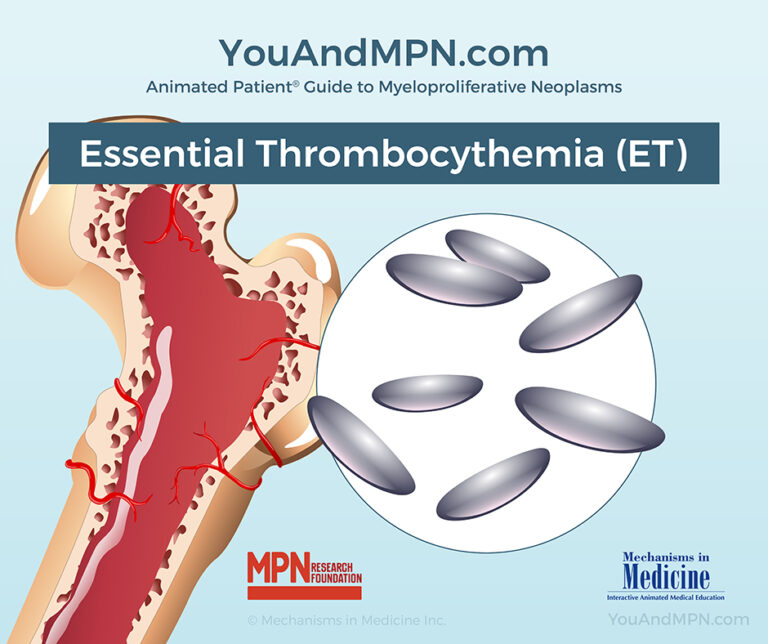
Understanding and Diagnosing Essential Thrombocythemia (ET)
Your blood is made up of several types of cells. Each type has an important job. Red blood cells carry oxygen, white blood cells fight infections, and platelets help stop bleeding when needed. Blood cells are made inside your bones, in the soft tissue called bone marrow. It works like a factory, making just the right amount of each blood cell type based on instructions from your genes.
Sometimes, the bone marrow factory receives the wrong instructions and starts making too many platelets. This is called essential thrombocythemia, or ET. It’s a type of blood cancer called a myeloproliferative neoplasm, or MPN. “Essential” means it’s the primary problem, not caused by something else.
Platelets help your blood clot when you’re injured. But when you have too many, they can form unwanted clots in your blood vessels or, surprisingly, sometimes cause bleeding. This happens because the blood becomes thick and doesn’t flow as well.1
ET is most common in women over age 50, though it can happen at older or younger ages. About 1 in 5 people with ET are under 40. Women are about 1.5 times more likely than men to develop ET.1
What causes essential thrombocythemia?
ET happens because of changes in genes, called mutations. These changes usually develop over a lifetime instead of being passed down from parents, or inherited.
Most people with ET have mutations in a gene called JAK2. Almost one-quarter have mutations in a gene called CALR, and a few have mutations in another gene, MPL. Some people have mutations in other genes, most often TET2, ASXL1, DNMT3A, and SF3B1.2 These genetic changes send signals that tell the bone marrow to make too many platelets.
What are essential thrombocythemia symptoms?
People with ET may not feel sick. ET is often discovered during a routine blood test that shows a high platelet count.1
When ET does cause symptoms, they can include headaches, dizziness, tiredness, night sweats, problems concentrating, or pain in the hands and feet. Some people feel cold sensations, notice a blue tint to their fingers and toes, or have vision problems.1,3
Some people with ET experience more serious problems such as blood clots, which can cause chest pain, shortness of breath, or leg swelling. Others might have easy bruising, nosebleeds, or heavy periods when platelet counts rise.1,3 There are other ET symptoms, so tell your doctor about any changes. Because ET can affect people differently, it’s important to speak with your doctor about any symptoms or changes.
How is essential thrombocythemia diagnosed?
ET is often discovered during a routine blood test that shows a high platelet count.1 If your blood test shows a high platelet count, your doctor may refer you to a hematologist – a doctor who specializes in blood disorders. They will run additional tests to determine what’s causing your high platelet count.1-4
Doctors use specific diagnostic criteria to confirm essential thrombocythemia. They look at your platelet count, bone marrow appearance, and gene mutations and check for other blood conditions. When all the pieces fit together, they can diagnose ET.4
Before diagnosing ET, doctors need to rule out other reasons for high platelets. They will test for iron deficiency, infections, inflammation, and other blood diseases that can cause high platelet counts.1
Your hematologist will test your blood for gene mutations – changes in the JAK2, CALR, and MPL genes and possibly others. Finding one of these mutations helps confirm the ET diagnosis, though not everyone with ET has one.1,2
Your doctor needs to take a small sample of bone marrow in a procedure called a bone marrow biopsy. This helps them see what’s happening inside your bone marrow “factory,” and make sure it’s really ET and not another condition.1,4
Post-ET myelofibrosis
Over time, a small number of people with ET (about 1 out of 10) may develop a related condition called post-ET myelofibrosis. This happens when scar tissue builds up in the bone marrow, which can cause anemia, fatigue, and an enlarged spleen.
Understanding your ET diagnosis and moving forward
Getting an ET diagnosis can feel overwhelming, but remember that many people with ET live normal, healthy lives. Your health care team will explain what the diagnosis means for you personally and help you understand the next steps in your care.1 Once ET is diagnosed, you can work with your health care team on a treatment plan. Understanding your ET is an important step towards managing it successfully.1
References
- MPN Research Foundation. What is essential thrombocythemia?
https://mpnresearchfoundation.org/essential-thrombocythemia-et - Tefferi A, Vannucchi AM, Barbui T. Essential thrombocythemia: 2024 update on diagnosis, risk stratification, and management. Am J Hematol. 2024 Apr;99(4):697-718.
- Thapa B, Fazal S, Parsi M, Rogers HJ. Myeloproliferative neoplasms. [Updated 2023 Aug 8]. In: StatPearls [Internet]. Treasure Island (FL): StatPearls Publishing; 2025 Jan-.
https://www.ncbi.nlm.nih.gov/books/NBK531464 - National Comprehensive Cancer Network (NCCN). NCCN Guidelines for Patients: Myeloproliferative neoplasms. [2024]
https://www.nccn.org/patients/guidelines/content/PDF/mpn-patient.pdf
Join the MPN Research community
Be the first to know about the latest news and advancements.
ALEX
ESSENTIAL THROMBOCYTHEMIA
Learn about Alex’s ET diagnosis and what he’s doing to make a difference in MPN research
