
EHA & ASCO clinical trial read outs: How these impact patient quality of life
Global leaders in MPN research took the stage presenting the latest clinical trial results at this year’s American Society for Clinical Oncology (ASCO) in Chicago, United States and European Association of Hematology (EHA) in Stockholm, Sweden.
One notable theme emerged across both ASCO and EHA this year: researchers are no longer focused solely on controlling symptoms of MPNs. Instead, many of the studies presented explored whether new therapies can more directly target the biology driving disease progression.
Across myelofibrosis and polycythemia vera, investigators reported encouraging signals in areas ranging from anemia improvement and spleen volume reduction to reductions in disease-causing mutation burden and prolonged disease control. Several key opinion leaders highlighted that these findings may represent a shift toward therapies designed for specific genetic mutations and combinations that target multiple disease pathways simultaneously.
While longer follow-up and larger studies will be needed, the breadth of promising data presented from phase 1 to real-world applications reflects a rapidly evolving MPN treatment landscape and a growing pipeline of therapies with the potential to address unmet patient needs.
Here are just some of the promising MPN treatments receiving attention at the latest conference season.
DISC-0974
Conference: ASCO 2026
Presentation: RALLY-MF: Initial efficacy of a phase 2 study of DISC-0974, an anti-hemojuvelin antibody, to treat anemia in myelofibrosis. (Gangat et al., 2026)
Clinical trial: RALLY-MF, Phase 2, NCT05320198, ongoing study evaluating safety and effectiveness in patients with anemia due to myelofibrosis
Patient population: Myelofibrosis (primary or secondary) with anemia, including patients who require blood transfusions
Corporate sponsor: Disc Medicine
Mechanism of action: DISC-0974 is a monoclonal antibody that helps the body access stored iron, allowing it to make more red blood cells and improve anemia
Key findings:
Study participants experienced meaningful improvements in anemia, with many patients increasing hemoglobin levels or reducing their need for blood transfusions.
The treatment reduced hepcidin levels and increased available iron, supporting red blood cell production.
Patients reported feeling better, including reduced fatigue, alongside measurable improvements in blood counts.
Patient impact: For people living with myelofibrosis, anemia can significantly affect energy levels, independence, and quality of life. The improvements in hemoglobin, reduced need for transfusions, and reported reductions in fatigue seen with DISC-0974 suggest the treatment could help patients feel better and spend less time managing anemia-related complications if future studies confirm these findings.
AJ1-11095
Conference: EHA 2026
Presentation: Results of AJX-101, a phase 1 clinical trial of the type II JAK2 inhibitor AJ1-11095 in patients with myelofibrosis who have been failed by a type I JAK2 inhibitor (Mascarenhas et al., 2026)
Clinical trial: AJX-101, Phase 1, NCT06343805, first study in humans, evaluates safety and dosing across multiple dose levels
Patient population: Myelofibrosis (primary or secondary), previously treated with a type I JAK2 inhibitor
Corporate sponsor: Ajax Therapeutics, Inc. now Eli Lilly and Co.
Mechanism of action (scientific): AJ1-11095 was discovered via a unique approach called computational chemistry in which the best protein design was determined through advanced structural analysis (Usart et al., 2025). AJ1-11095 is thought to lock the JAK protein in its “off” state, preventing the excessive signaling which causes dysfunction.
Key findings:
Study participants achieved high rates of spleen volume reduction, with 70% of patients reaching at least a 35% reduction (SVR35) and 83% reaching at least a 25% reduction.
Patients reported strong symptom improvement, with about 70% achieving meaningful reductions in symptom burden (TSS50) by weeks 12.
The therapy reduced the burden of cancer-driving mutations (variant allele frequency), suggesting it may modify the disease beyond symptom control.
Patient impact: As an MPN patient's response to JAK inhibitors wane, they need new and effective therapeutic options. In this early study, AJ1-11095 was able to decrease the levels of cancer-driving mutations in patients post-JAK inhibitor use. While these findings need to be confirmed in larger studies, they suggest the possibility of a treatment that could impact the underlying biology of myelofibrosis, not just provide symptom relief.
Selinexor + ruxolitinib
Conference: ASCO 2026 and EHA 2026
Presentations:
ASCO — Selinexor plus ruxolitinib in janus kinase inhibitor–naïve myelofibrosis: phase 3 SENTRY trial (Mascarenhas et al., 2026)
EHA — Selinexor plus ruxolitinib in janus kinase inhibitor–naïve myelofibrosis: phase 3 SENTRY trial (Harrison et al., 2026)
Clinical trial: SENTRY, Phase 3, NCT04562389, randomized study evaluating selinexor in combination with ruxolitinib
Patient population: Myelofibrosis (primary or secondary), JAK inhibitor–naïve
Corporate sponsor: Karyopharm Therapeutics
Mechanism of action: Selinexor blocks a protein called XPO1 that helps move important regulatory molecules out of the cell nucleus. By blocking this process, selinexor is thought to help restore normal cell control mechanisms.
Key findings:
Study participants receiving selinexor plus ruxolitinib achieved significantly higher rates of spleen volume reduction compared with ruxolitinib alone, with deeper and more sustained responses over time.
Both treatment groups experienced similar reductions in symptom burden from baseline.
The combination showed early signs of improved overall survival, along with reductions in cancer-related mutation levels (VAF), suggesting potential effects on the underlying disease.
Patient impact: For people living with myelofibrosis, meaningful treatment goals include not only symptom relief but also slowing the progression of the disease. The combination of selinexor and ruxolitinib produced deeper spleen responses than ruxolitinib alone, with the authors stressing that this is the first time in the field where spleen response predicted overall survival. Authors were also encouraged that the decrease in mutated cells (variable allele frequency or molecular response) showed a relationship with clinical outcomes.
Luspatercept (Reblozyl®)
Conference: EHA 2026
Presentation: Efficacy and safety of luspatercept in patients with myelofibrosis on janus kinase inhibitors who require red blood cell transfusions: primary analysis of the phase 3 INDEPENDENCE trial (Passamonti et al., 2026)
Clinical trial: INDEPENDENCE, Phase 3, NCT04717414, randomized study
Patient population: Myelofibrosis (primary or secondary) receiving JAK inhibitors with anemia requiring regular red blood cell transfusions
Corporate sponsor: Bristol Myers Squibb
Mechanism of action: Luspatercept is thought to help red blood cells mature properly during the final stages of development. By supporting later steps in red blood cell production, it addresses a key cause of anemia in myelofibrosis.
Key findings:
More patients treated with luspatercept achieved periods without needing blood transfusions compared with placebo, although the difference did not reach statistical significance in the primary analysis.
The treatment showed a manageable safety profile and may provide an additional option for patients whose anemia persists during JAK inhibitor therapy.
Patient impact: For patients with myelofibrosis whose anemia persists despite JAK inhibitor treatment, luspatercept may offer another way to improve red blood cell production and reduce reliance on blood transfusions, a meaningful outcome for daily functioning and quality of life. The authors plan to look more closely into the difference in placebo effect that appeared to depend on geographical region.
INCA033989 + Ruxolitinib
Conference: EHA 2026
Presentation: Mutant calreticulin–specific monoclonal antibody, INCA033989, is well tolerated and achieves robust spleen, anemia, and molecular responses in patients with myelofibrosis (pts) with myelofibrosis (Harrison et al., 2026)
Clinical trial: Phase 1, NCT05936359 and NCT06034002, first-in-human studies evaluating INCA033989 as a single agent or in combination with ruxolitinib
Patient population: Calreticulin (CALR)-mutated myelofibrosis, including patients who were resistant or intolerant to JAK inhibitor therapy
Corporate sponsor: Incyte Corporation
Mechanism of action: INCA033989 is a monoclonal antibody designed to recognize and selectively bind cells that carry the mutant CALR protein to block cancer-driving signals while sparing healthy cells.
Key findings:
Participants experienced meaningful reductions in spleen volume, with 31% achieving at least a 35% reduction in spleen size (SVR35) after 24 weeks of treatment.
Many patients experienced improvement in anemia, with 58% of evaluable patients achieving an anemia response during treatment.
The treatment reduced levels of mutant CALR cells and lowered mutation burden in most patients (VAF), suggesting it may directly target the underlying biology of CALR-mutated myelofibrosis.
Patient impact: By reducing levels of mutant CALR cells, this study suggests that INCA033989 may be targeting the disease at its source. For patients with CALR-mutated myelofibrosis, this raises the possibility of a more precise treatment that could help alter the course of the disease, not just manage its symptoms.
Divesiran (SLN124)
Conference: EHA 2026
Presentation: Divesiran, a novel GalNAc-conjugated siRNA, reduces phlebotomies, improves iron stores and symptoms in polycythemia vera patients in SANRECO phase 1 study (Kremyanskaya et al., 2026)
Clinical trial: SANRECO, Phase 1/2, NCT05499013, dose-finding study
Patient population: Polycythemia vera patients requiring frequent phlebotomy treatment alone or with a cytoreductive therapy
Corporate sponsor: Silence Therapeutics plc
Mechanism of action: Divesiran is a small interfering RNA (siRNA) therapy designed to increase levels of hepcidin, a hormone that controls how iron is used in the body. Divesiran is thought to help control the overproduction of red blood cells seen in polycythemia vera.
Key findings:
Patients treated with divesiran required significantly fewer phlebotomies during the study period compared with before treatment, indicating improved control of hematocrit levels. Follow up data suggests continued delays in phlebotomy needs after the last dose.
The therapy reduced iron levels in the blood and improved iron regulation.
Patients also reported significant symptoms improvement, and the treatment was generally well tolerated with no serious treatment-related adverse events reported.
Patient impact: Frequent phlebotomies can be burdensome for people with polycythemia vera and may contribute to iron deficiency and related symptoms. By reducing the need for phlebotomies while improving iron regulation and symptoms, divesiran has the potential to make disease management less disruptive and improve patients' quality of life.
While many of the trials highlighted throughout this roundup focus on individual therapies, one ASCO 2026 presentation offered a broader perspective on how the MPN treatment landscape is evolving. In an analysis of real-world outcomes in patients with myelofibrosis who discontinued ruxolitinib, Dr. Andrew Kuykendall, MD, and colleagues found an encouraging trend.
The real-word data presented in their poster shows that myelofibrosis patients diagnosed more recently experienced longer survival than patients diagnosed in earlier years. The Kaplan-Meier curves in Figure 4 of his poster demonstrate this encouraging trend, with survival improving among a group of patients diagnosed after 2016 and again among a separate cohort diagnosed after 2019.
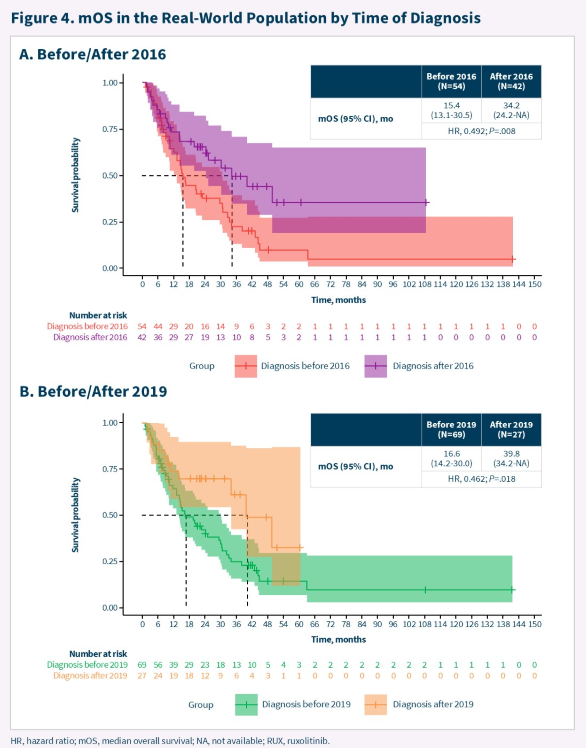
Caption: Median overall survival in patients with myelofibrosis, grouped by year of diagnosis. The Kaplan-Meier curve shows the probability of survival over time after stopping ruxolitinib treatment. In both cohorts compiled in A. and B. patients diagnosed more recently had longer median overall survival than those diagnosed in earlier years, suggesting that evolving treatment options and changing treatment strategies may be improving outcomes for patients with myelofibrosis. Adapted from Kuykendall et al., 2026.
According to Dr. Kuykendall, the improvement likely reflects two converging trends: “Patients are not only benefiting from more treatment options than ever before, they are also being transitioned to those options earlier,” he explained (personal correspondence). Together, these findings suggest that advances in both drug development and treatment strategy may already be translating into better outcomes for patients with myelofibrosis.
The improving survival trends observed in real-world practice suggest that progress in MPN research is beginning to translate into meaningful benefits for patients.
Taken together, the findings presented at ASCO and EHA 2026 point toward a future with more treatment choices, targeted therapies, and opportunities to participate in clinical trials. While challenges remain, the combination of new drug approvals, innovative investigational therapies, and a growing understanding of when to change treatment strategies offers reason for optimism.
Sources:
Gangat, N., Tefferi, A., Bose, P., Hexner, E. O., Michaelis, L. C., Gerds, A. T., Jain, A. G., Islam, P., Rampal, R., Swords, R. T., Talpaz, M., Pettit, K. M., Bhatt, S., Buch, A., Pelletier, O., Savage, W., & Halpern, A. B. (2026). RALLY-MF: Initial efficacy of a phase 2 study of DISC-0974, an anti-hemojuvelin antibody, to treat anemia in myelofibrosis. Journal of Clinical Oncology, 44(16_suppl), 6501–6501. https://doi.org/10.1200/JCO.2026.44.16_suppl.6501
Harrison, C., Al-Ali, H. K., Garcia Gutierrez, V., Grosicki, S., Grudeva-Popova, Z., Kwiatek, M., Loschi, M., Passamonti, F., Patriarca, A., Urian, L., Ali, H., Hong, J., Hou, H.-A., Jain, T., Podoltsev, N., Miljkovic, D., Chai, Y., Taverna, P., Sadiq, A., Rangwala, R., Vachhani, P., Bose, P., & Mascarenhas, J. (2026). Selinexor plus ruxolitinib in janus kinase inhibitor–naïve myelofibrosis: phase 3 SENTRY trial. EHA Library, European Hematology Association (EHA) 2026 Annual Congress, Abstract LB5002 (4214969).
Harrison, C., Gupta, V., Al-Ali, H. K., Ali, H., Mascarenhas, J., Passamonti, F., Gerds, A. T., Mohan, S., Palandri, F., Psaila, B., Rampal, R. K., Shomali, W., Ross, D., Ribrag, V., Bradley, T., How, C.-J., Koschmieder, S., McNamara, C., Perkins, A., Yacoub, A., Gotlib, J., Nangalia, J., Tian, C., Lamothe, B., Crowgey, E., Zinger, T., Braunstein, E., & Jain, T. (2026). Mutant calreticulin–specific monoclonal antibody, INCA033989, is well tolerated and achieves robust spleen, anemia, and molecular responses in patients (pts) with myelofibrosis (MF). EHA Library, European Hematology Association (EHA) 2026 Annual Congress, Abstract S216 (4206770).
Kremyanskaya, M., Hoffman, R., Chew, L. P., Sharif, A., Semov, B., Kori, A. N., Sia, H., Grove, C., Ng, A., Kalro, A., Raman, I., Kasinathan, G., Perkins, A., Szarek, M., Allison, N., Oduwole, O., Gomez-Palou, M., Fok, H., Romano, S., Rambaran, C., & Martinez, A. (2026). Divesiran, a novel GalNAc conjugated siRNA, reduces phlebotomies, improves iron stores and symptoms in polycythemia vera patients in SANRECO phase 1 study. EHA Library, European Hematology Association (EHA) 2026 Annual Congress, Abstract PF886 (4207874).
Mascarenhas, J., Bose, P., Ali, H., Al-Ali, H. K., Garcia-Gutierrez, V., Grosicki, S., Grudeva-Popova, Z., Harrison, C., Hong, J., Hou, H.-A., Kwiatek, M., Loschi, M., Passamonti, F., Patriarca, A., Podoltsev, N., Rampal, R., Tantravahi, S., Urian, L. G., Chai, Y., … SENTRY Trial Investigators. (2026). Selinexor Plus Ruxolitinib in Janus Kinase Inhibitor-Naïve Myelofibrosis: Phase III SENTRY Trial. Journal of Clinical Oncology: Official Journal of the American Society of Clinical Oncology, JCO2601080. https://doi.org/10.1200/JCO-26-01080
Mascarenhas, J., Borate, U., Bose, P., Byrd, J., Garcia, J., Gotlib, J., Grunwald, M., Hobbs, G., Kuykendall, A., Mesa, R., Oh, S., Pettit, K., Rampal, R. K., Shomali, W., Srisuwananukorn, A., Vick, E., Yacoub, A., & Steensma, D. (2026). Results of AJX-101, a phase 1 clinical trial of the type II JAK2 inhibitor AJ1-11095 in patients with myelofibrosis who have been failed by a type I JAK2 inhibitor. EHA Library, European Hematology Association (EHA) 2026 Annual Congress, Abstract S218 (4206772).
Passamonti, F., Kiladjian, J.-J., Mascarenhas, J., Harrison, C., Mesa, R., Abruzzese, E., Gill, H., Wickenhauser, S., Lee, J.-H., Xiao, Z., Pane, F., Chen, S., Zhao, C., Symeonidis, A., Sanabria, F., Vienne Bürki, J., Giuseppi, A. C., Li, J., Farazi, T., & Al-Ali, H. K. (2026). Efficacy and safety of luspatercept in patients with myelofibrosis on janus kinase inhibitors who require red blood cell transfusions: primary analysis of the phase 3 INDEPENDENCE trial. EHA Library, European Hematology Association (EHA) 2026 Annual Congress, Abstract S215 (4206769).
Usart, M., Rai, S., O’Connor, K., Kimmerlin, Q., Zaroogian, Z., Wereski, M., Xu, C., Masse, C., Hubbard, S., Levine, R., Kleppe, M., Skoda, R., & Dunbar, A. (2025). AJ1-11095, a potent and highly selective type-II JAK2 inhibitor, shows enhanced therapeutic efficacy as compared with type-I JAK2 inhibitor ruxolitinib in models of myeloproliferative neoplasms (MPNs). Blood, 67th ASH Annual Meeting Abstracts, 146, 1983. https://doi.org/10.1182/blood-2025-1983