
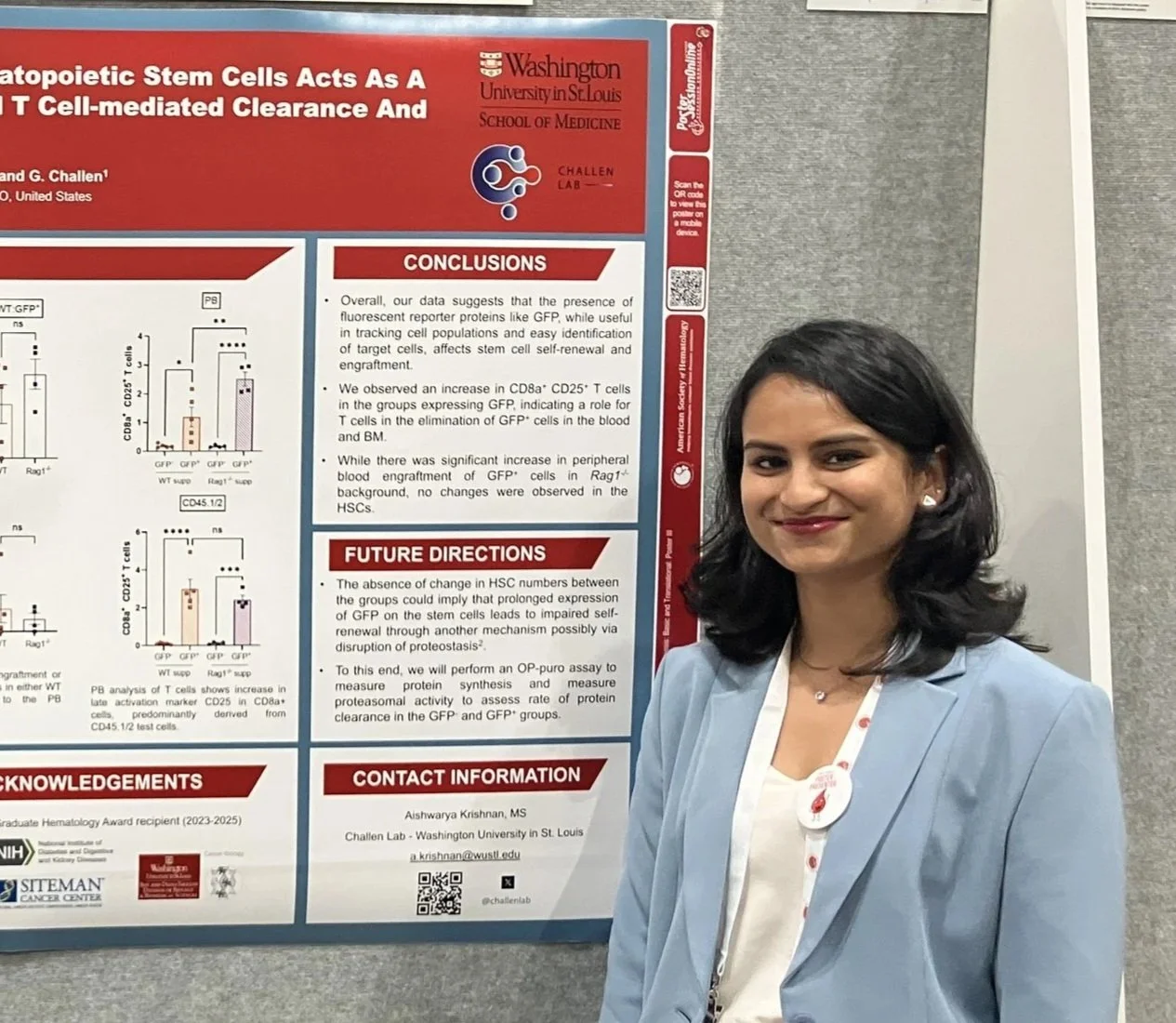
Aishwarya Krishnan presents an Abstract Achievement Award poster at the American Society of Hematology conference in 2025
On some winter mornings, Aishwarya Krishnan leaves her laboratory and starts the walk to the mouse facility on the far side of campus. It takes about 7 minutes. In mild weather, it is an inconvenience. In a Midwestern winter, it becomes a small expedition.
She describes the familiar routine: "just like head down, bent against the wind. Just a single minded focus to get to the mouse house."
The destination is worth it. Aishwarya is a 6th year PhD student in the cancer biology program at Washington University in St. Louis. She’s bright and driven, presenting complex posters at international conferences in the later stages of her graduate school career. Her days are dedicated to studying the biological events that push pre-cancerous blood stem cells toward leukemia. Her work relies heavily on mouse models, despite a complication that would make many scientists reconsider their path.
"I have a huge allergy to mice,” she confesses. She learned of her predicament during the first week of working with mice. “I’ve been working with mice for 8 years now and it's been a strong uphill battle."
Yet every day she keeps showing up.
The image feels symbolic of graduate school itself. Long days. Uncomfortable conditions. Experiments that go sideways. Questions that refuse to yield easy answers. And students like Aishwarya, who continue anyway.
These are the early years of scientific discovery, where future researchers quench their desire for challenges.
Learning that failure is part of discovery
When many students begin graduate school, they imagine science as a straight path from a question to an answer. Reality has more in store, including a failure to prove one’s hypothesis, called a negative result.
"I think the biggest [lesson] for me has been normalizing negative data," she says. "You come in fresh and you have this great dream in your head that you're going to ask a question, everything is going to work out."
Instead, experiments often reveal that an initial idea was wrong. Then another idea proves wrong. Then another.
“Initially, I had a hard time wrapping my head around the fact that the question I asked was not what was happening. So, I modified my original question based on my data, but this did not provide any answers either” she explains the all too familiar scientific method. "It chips away at your morale a little bit," she admits.
Those dead ends can feel discouraging, but they also serve an important purpose. Negative findings help direct future researchers away from unproductive paths and toward better questions.
Science rarely advances in a straight line. More often it takes what Aishwarya describes as "a circuitous route" to reach meaningful answers. That reality demands perseverance.
Some days in graduate school stretch to 14 hours. Other days are consumed by writing, data analysis, or trying to understand what a collection of experiments means when viewed together.
The challenge is the point
Aishwarya 's attraction to biology comes from the complexity that frustrates and fascinates scientists in equal measure.
She loves studying biology and cancer specifically because "it's not just a one layer or a two layered scenario," she says. "There’s so much that's changing in the body," she says. "It's like peeling an onion. There's so many things that you have to look at to get to the answer." That complexity is exactly what keeps her and her colleagues in cancer biology engaged.
Years into her graduate school program, that mindset is guiding her career decisions. As the time when she will defend her doctorate thesis approaches, Aishwarya is exploring postdoctoral opportunities and thinking carefully about what comes next.
"I guess challenging myself [in a post-doctoral position] a little bit would be something that I'm looking forward to," she says, discounting for the moment, her current hardships.
She hopes a future “post doc” position will expose her to new scientific questions and perhaps different disease areas before eventually moving into translational research and drug development. Her goal is to help move discoveries from the laboratory toward patients.
Science does not end when the experiment does
One of the biggest surprises for people outside academia is how much scientists love talking about their jobs after hours.
Graduate students spend countless hours discussing ideas with mentors, committee members, postdoctoral fellows, and fellow students on campus and at familiar local watering holes. Those conversations often unlock new ways of viewing a problem.
"When I'm doing a project, I tend to only think about a single approach," Aishwarya says. "I go into this very narrow rabbit hole." It’s up to other scientists, especially her mentors, to provide the perspective she needs.
For graduate students, those exchanges are not optional. They are essential. "Have you thought about it this way?" colleagues ask, prompting entirely new avenues of thinking.
Back when she was rotating though prospective laboratories, Aishwarya often got together with members of the lab to talk about experiments, frustrations, career goals, and the realities of academic life. “These candid conversations often help prospective graduate students learn about the lab culture and environment, which helps them decide whether the lab would be a right fit for them”.
The conversations were candid. Students and trainees could speak openly about experiments, frustrations, career goals, and the realities of academic life. Outside the laboratory, people were often more willing "to give me honest opinions," she says.
Those gatherings continue in different forms today. Sometimes they involve discussing new scientific ideas. Sometimes they involve collectively venting about difficult projects.
More often, they are both.
"My cohort gets together and we all talk about how everything sucks at the moment," Aishwarya says with a warm smile. But those conversations serve a deeper purpose. It provides the ability to reframe scientific setbacks: "OK, I'm not alone in this. Everybody's struggling."
That sense of community helps sustain young scientists through the inevitable setbacks. Because in research, there is no closing bell. The experiments may end for the day. The questions rarely do.
Building the future of MPN research
For nearly a decade, Aishwarya followed scientific questions wherever they lead, from an undergraduate research experience in India to cancer biology and blood cancer research in the United States. Along the way she discovered that science is rarely simple, often frustrating, and endlessly compelling.
The same curiosity that first drew her into research continues to drive her today. That curiosity has carried her through failed experiments, difficult winters, mouse allergies, long days, and the uncertainty that comes with tackling some of biology's hardest questions.
Now, as she approaches the finish line of graduate school, she is already looking toward the next challenge.
For patients with myeloproliferative neoplasms (MPNs) and other blood cancers, researchers like Aishwarya represent something essential: the next generation of scientists willing to take on difficult problems, ask better questions, and keep moving forward despite the challenges.